
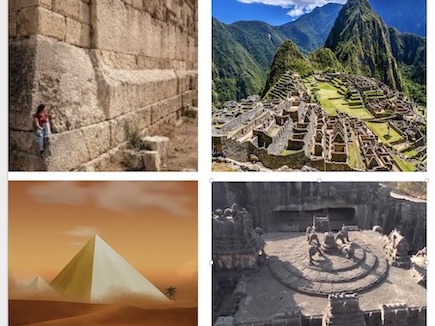
Take a look at these 5 incredible ancient architectural structures. How did the ancient civilizations build them? Even today, engineers with modern engineering technology at their disposal are seriously challenged by how they could build and reproduce these structures.
What extraordinary achievements: How could the ancients have cut these massive structures out of the matrix stone, moved them quite a distance away, then, at the chosen location, carved them into the desired shapes with incredible geometric precision. How were they then put into position with such accuracy…?
These structures have remained where they are now for thousands of years. Nobody has been able to move them!
Officialdom claims that they used primitive tools, but really, just how advanced were these ancients? Did they have “outside influence…?” Did they even build them at all? Was some long-forgotten technology used to shift these stones weighing hundreds of tons? These are the questions that demand real answers.
-In light of this, here are 5 ancient architectural structures modern engineering cannot build today.
1. Temple of Jupiter Platform located in Baalbek, Lebanon .
The stones located at the lower (foundational) levels of this ancient architectural structure are said to be the heaviest stones ever moved, weighing some 1,000 plus tons. -That’s about the weight of 2 to 3 jumbo jets fully filled with passengers see above picture top left).
The method by which these stones were moved is still hotly debated. They fit together so well that you could not insert feeler gauges in between them… They have survived thousands of years of weathering, showing no cracks.
These stones (blocks) predate the surrounding Corinthian temple complex built by the Romans. The Romans started building the complex around the time of 16 BC.
2. The Machu Picchu
The Machu Picchu citadel is located high in the Andes Mountains, Peru. It was built by the Incas. Another one of the ancient architectural structures that, unlike the one above, sits on a mountain ridge at 8000 feet above sea level (above picture top right).
The Machu Picchu is next to two active earthquake lines (one on each side). In spite of its somewhat precarious location, after hundreds of years the Machu Picchu has managed to keep its structural integrity.
It has survived earthquakes and heavy tropical rainstorms that have found their way to this site year in, year out. The citadel has a complex drainage system to drain the water and mudslides away, down the mountain slopes.
Not using glue or mortar, its ancient architectural structures, such as the huge stone blocks, had been meticulously put together in a sophisticated way. Having many angular cuts and corners, the stones had fused together forming what might be described as a complex jigsaw puzzle.
Some of the buildings there curiously have astronomical alignments…
What was Machu Picchu used for? We don’t really know, as it’s a mystery.
3. The Great Pyramid of Giza
The formation of this staggeringly monumental pyramid on the Giza Plateau, Egypt, consists of some 2.3 million single stone blocks. -Another one of those ancient architectural structures that has some mind-boggling feats of engineering, especially when the ancients were said to only have primitive tools (above picture bottom left).
Not even today’s technology; large cranes, pick-up trucks, caterpillar tractors, special drilling machines… etc., would be able to transport, cut the 20-60 plus tonnes stones and put them into place with geometrical precision-like accuracy in the same way as the Great Pyramid of Giza.
Officialdom, antiquity, claims that it was completed in 2,600 BC, having taken 20-27 years to complete. It is claimed to be a burial ground for the Egyptian Pharaoh known as Khufu (aka Cheops).
However, this explanation has had some serious challenges. Challenges include:
*No mummified body has been found at the Giza Pyramid
*No treasures there which are commonly found in other locations where ancient Egyptian royalty had been buried
*No fancy artworks or hieroglyphics, something you also expect at a tomb
*The pyramid had a capstone and an overall smooth shiny white-stone coating looking like one gigantic mountain-sized stone shining brightly in the desert sun…
*Further, did you know that the chemical composition of the pyramid stones is different to the matrix stone (granite) nearby at the Giza plateau? On chemical analysis the pyramid stones are harder, as they had been treated with a resin-type material and contained metallic substances amongst other materials, allowing electrical conductivity.
-Do you really think that the ancients would take all this trouble over building a mere burial ground??
*The water erosion patterns (fluvial erosion) on the Sphinx indicate that the structure along with the Great Pyramid, is much older than 2,600 BC. According to researcher Robert Schoch, the age is more like 1,500 years ago when the waters of the last Ice Age were receding…
*Other researchers such as the likes of Christopher Dunn put forward the case that the pyramid was not a burial ground, but a “power plant.” -I would recommend finding out more on this fascinating claim.
4. Kailasa Temple
The building of the Kailasa Temple was unique. It was built in the 8th century by carving rock starting at the top of a mountain. Then the workers carried on carving straight downwards to eventually complete its entire temple formation.
This amazing work involved carving through some 200,000 tons of solid stone to form the resulting structures (above picture bottom right).
All the things you can see at this temple: the support columns, floor levels, rooms, statues, other stone artifacts… took about 20 years to complete the entire complex. Remember, it was said this had been done using primitive tools.
5. Sacsayhuamán ancient Fortress
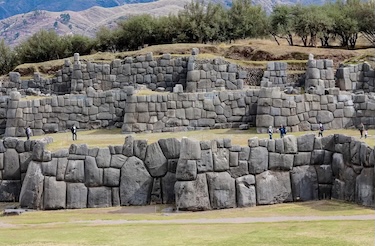
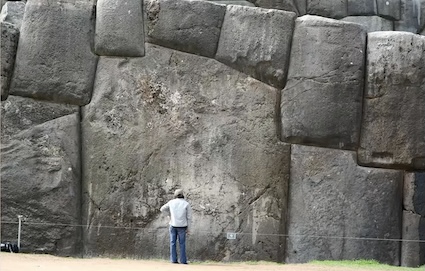
This one of the featured ancient architectural structures is an ancient citadel built in the 15th century, in the outer regions of Cusco, Peru.
There were some massive stones used to construct this site. Some are over 120 tons. These stones had also been cut into different shapes, such as those that had been shaped into curvatures. The stones had been grouped together to form an amazing complex 3-D orientation.
The stones comprise hard granite and dark limestone and had been so well put together; no cement or mortar you cannot see any gaps between their assembly. This citadel has survived a number of earthquakes over the many years.
Finally
That concludes my all-too-brief account showing just 5 of the many ancient architectural structures that modern-day engineering cannot build.
The above reflects on so many cases whereby some massive stones were used. If, as with ancient architectural structures such as the Temple of Jupiter Platform, Baalbek, Lebanon and the Giza Pyramid, Egypt, the ancients only had primitive tools why did they take the trouble to erect such massive stones?
-Wouldn’t it have been much more practical to use smaller stones?