
Vaccines are said to be the harbinger of good health: They have eradicated major ‘life-threatening epidemics’, ever since the first so-called successful vaccination was made. History asserts how large populations have survived and will continue to, thanks to this wonderful medical intervention. – Viva vaccines!
The press has always given more than their fair share of support for vaccines and so have the public at large, but should we really be that accepting?
Over the years, care of the internet, more and more information comes slowly trickling through, challenging our faith in the vaccines religion. In order to show that the picture painted of vaccines is not so glossy at all, it is necessary to go right back to the beginning of its history:
The official front line puts Jenner down in history as a man who gave a great gift to the world, saving the lives of countless numbers through his medical breakthrough. He was the founder of vaccinations.
It was said that he made the first successful vaccination in his hometown of Berkley, Gloucestershire. The official biography goes on to say, Jenner knew that milkmaids did not die of the deadly smallpox disease because of protection given by the non-life-threatening cowpox they had contracted from handling the udders of cows. He observed how the milkmaids had developed pustules on their fingers, a manifestation of cowpox. He thought that the pus would offer protection from smallpox.
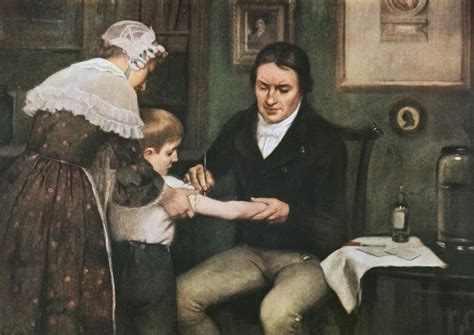
So, for his first experiment (which is famous throughout the world), Jenner took the pus from the hand of a milkmaid and introduced it via two cuts he had made into the arm of a young boy called James Phipps. He made more pus introductions over the next few days. Then, to put his theory to the test, Jenner injected the boy with smallpox. At first, the boy was unwell, but after a matter of several days, he fully recovered, with no side effects seen.
-It has been said that a great discovery was made.
-Or was it?
The Truth about Edward Jenner
On closer inspection, the official frontline story differs greatly to what really happened. To give you an idea of the background, here are some of the biographical features you will not find in an orthodox medical textbook:
*Jenner never passed an exam in his entire life.
*He bought his doctor of medicine (MD) for just over £15 at St Andrews University, Scotland
*Later, Oxford University gave him another MD. His theory on vaccination was more than an influence on getting the qualification.
*Having pulled a few strings, he was made a fellow of the royal society (FRS) for submitting a paper entitled ‘The Natural History of the Cuckoo!!’
*Qualified or unqualified, medical treatment in this era was nothing short of barbaric. Slashing veins for bloodletting, applying leeches, amputations and removing kidney stones (without anaesthetics and gangrenous Infections frequently occurring as a consequence) were all common practices of the day, in which Jenner was “skilled” at.
*The principle behind vaccines, isopathy; giving someone an attenuated form of the disease to make the body produce antibodies against it and thus becoming immune was not a new idea. It can be traced as far back as ancient Greece. Hence the famous saying by Hippocrates: ‘Where there is illness there is also the cure.’
The truth behind the circumstances surrounding Jenner’s famous experiment on the young boy James Phipps and his claims to being the creator of the successful smallpox vaccine in 1796.
The first thing to realize is that most of Jenner’s medical contemporaries hotly disputed his claims. His was even ridiculed. A number of veterinarians would have told him that unlike the milkmaids he claimed to not contract smallpox, countless individuals did as a result of having had cowpox. Hence, Jenner or any other vaccinator never proved that cowpox gave immunity to smallpox in this era. Nor is there proof in any medical / pharmaceutical research institutions to this day. That means the whole basis for smallpox vaccination remains fundamentally flawed.
In my research, I was astounded to find that, in later years a friend and colleague called John Baron MD wrote a kindly biography on Jenner, published in 1838 and in it, Baron recalls how Jenner and other medics at the time of trying to create a vaccine did not find that cowpox was capable of preventing smallpox. The biography goes on to say that this did not dampen his hopes in trying and find a solution, even if the cowpox infected milkmaids DID eventually get smallpox!
Further attempts
Later, Jenner made modifications to his cowpox matter vaccine. He added horse-grease. This was made up of seborrhoeal legions; a scaling disorder of the skin on horses’ hoofs caused by poor sanitation in stables.
Jenner hailed this new concoction of horse-grease cowpox as ‘the life-preserving fluid.’ He went on to make many correspondences regarding its life-saving virtue. However, one slight thing had to be done. He needed to try it out to see if it worked!
He inoculated a young boy called John Baker with horse-grease. Then, unfortunately, before Jenner could continue and inoculate Baker with smallpox, to see if it would take, the experiment came to a halt. The boy died of a fever.
Jenner tried other children, including his own son. Some were treated with variations on his vaccine formulation, such as the inclusion of swinepox, but to no avail. These children were also not infected with smallpox to see if it would take.
In spite of the experiments failing to prove the resistance to smallpox from inoculation, after four years, Jenner continued making his claim to the efficacy of the vaccine. He declared he had named it ‘vaccinia vaccinae’(Latin for smallpox of the cow, which, I guess, gives some scientific overtones into something that is otherwise not!) and said it gave immunity against smallpox for
life!
Animal then human torture fraud
The production of smallpox was made in a most barbaric way: Shaving the fur off the abdomens of cows, making cuts across this area, and inserting pus from human smallpox into the wounds. Then, not allowing licking the wounds, the cows become diseased and scrapings were made from their bellies. The scrapings collected, consisted of skin, flesh, festering pus, blood and hair:
-This was the vaccine.
The vaccine was introduced into humans by making cuts in their arms and inserting it into the wounds. Because there was no such thing as a refrigerator in those days, vaccine supplies were limited; so, one individual inoculated in this way then immediately passed on the inoculation to another by making cut arm to cut arm contact. The second inoculated individual would then pass the inoculation on to another in the same way and so on…
It doesn’t take someone reading this with qualifications in microbiology to realize that the method of transfer was very risky. The technique used allowed individuals to unknowingly infect others with a whole range of different possible diseases. Many of the victims were children. This blood-borne spreading of infections and diseases included: Tuberculosis, pneumonia, brain damage, leprosy, syphilis, ulcerative sores starting at the point of vaccination then spread throughout the body causing a rotting away… Cases of this form of spreading all these diseases are well documented. For example, it was recorded in early nineteenth century Italy that over sixty children contracted syphilis during one vaccination session.
So here you not only have a vaccine that was useless but also by the way it was introduced caused even more death and suffering though secondary infections. This arm-to-arm vaccination technique, allowing diseases to spread between animals and humans was not banned until the late nineteenth century.
Does something not add up here?
Curiously enough, media sources such as Encyclopaedia Britannica, ABC News, Nova Science and numerous other mainstream medical literatures tell us that the smallpox vaccination used today is cowpox, keeping the myth going. There are other sources like the Centre for Disease Control (CDC) that doesn’t claim the vaccine is cowpox, but does not reveal the shoddy science and quackery related to smallpox vaccinations.
At this stage, readers may wonder how on earth Jenner’s baseless theory and insane practice of vaccination ever took off. How did he manage to pull the wool over the eyes of so many doctors, surgeons and politicians of the day?
The explanation can relate to some age-old principles that can be connected to the medical / pharmaceutical establishment today. Even all these years ago, we can see corruption was going on.
-The first thing to realise is that contrary to what is believed, many doctors DID NOT accept Jenner’s work on vaccination and they were quick to respond after its introduction: Following the go ahead with vaccinations from the medical establishment, there soon followed an anti-vaccinationist resistance movement all over the country with good science to support their views.
“Out of 504 vaccinated in England, 75 died from the vaccine and almost all have had the small-pox, some sooner, some later, after their vaccination. There is no question here of supposition or calculation of probability, it is truth!” -Dr. William Rowley, a member of the University of Oxford and of the Royal College of Physicians in London 1805
This suppression and obfuscation of the truth behind smallpox vaccination is still going on to this day.
Lavish fortune
In spite of all the protest, the evidence against vaccination, the real reason for its continuation could be found within the very top of the medical / political hierarchical tree.
Even though Jenner floundered, failing to complete his experiments on the young boys, he still zealously carried on with his work. To help him and encourage his erroneous ways, the political power players of the UK government gave him the huge sum of 10,000 pounds in 1802 (estimated to be around 300,000 today).
So, in answer to my question earlier: how did Jenner manage to pull the wool over the eyes of so many doctors, surgeons and politicians of the day?
In my opinion, contrary to what some alternative writers put down, I’d say, he definitely didn’t. I believe that it was the other way round. That the power players at the top of the hierarchical tree somehow knew his ideas were based on quackery and would fail: Jenner, deluded by money, praise and attention thus carried on. The protests from doctors with their sound science, proving that the vaccinations caused more harm than good fell on deaf ears and were even suppressed because the powers that be saw it as an opportunity; a business enterprise with huge profits.
–And that is what it turned out to be. Choosing moneymaking enterprises over the welfare concern of people still goes on today with the medical / pharmaceutical establishment.
The generous government grants kept coming Jenner’s way. He had received 30,000 pounds in total. John Born in his biography recalls how Jenner thought that he had been divinely chosen to relieve the world of one of the world’s greatest calamities; smallpox. However, when Jenner died in 1823, he had not presented one scrap of scientific evidence to prove the efficacy of his vaccine.
The arm of the law
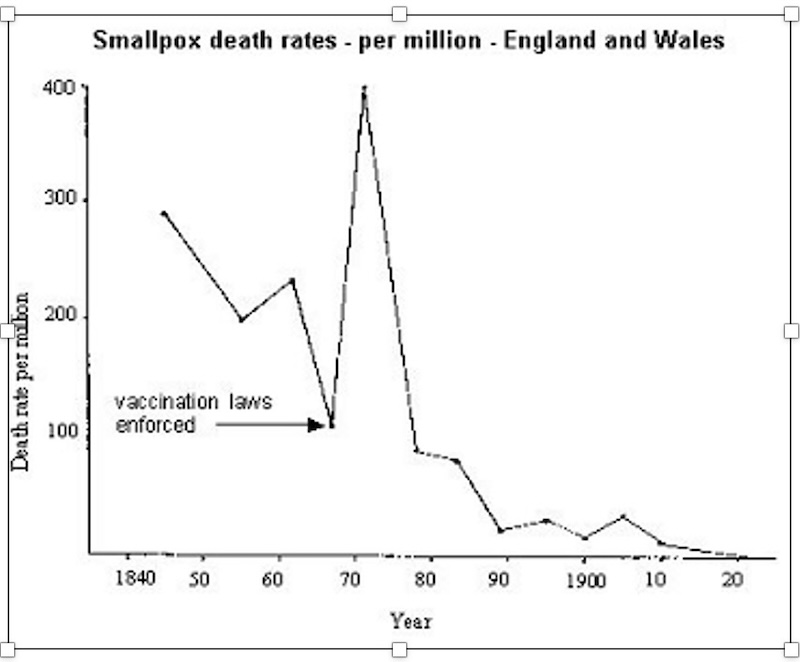
By 1870, the authorities made vaccinations compulsory. Besides the UK, most European countries were under threat of fines and imprisonment if any other practice was used. The evidence that the vaccine did more harm than good in this era can be shown by the graph below.
Source: The Role of Medicine Prof T. McKeown Oxford Univ Press 1976 9.
Take for instance the case of Leicester, England:
Most smallpox mortality was in years with most vaccination:
Small-pox inoculation, in its day, was as rife in Leicester as anywhere. The practice of vaccination followed…
It is futile, therefore, for anyone to allege that, in the great pandemic years of 1871-73, Leicester was an unvaccinated—or, to use the modern medical term, an “unprotected”—community. Whatever “protection” vaccination could afford as a preventive of small-pox, Leicester undoubtedly enjoyed at that time. But in those dreadful and fateful years, several thousands of our “protected” (?) people were mercilessly attacked by small-pox, until the fruitless attempt to count the numbers was abandoned in despair, and the required information entirely lost. The fearful death roll of 360 victims formed the only basis upon which any sort of calculation could be made as to the approximate number of small-pox cases which then occurred in the town.
Need anyone wonder that the belief in the prophylactic virtues of vaccination rapidly dwindled? Particularly so, because with the decline of vaccination came a diminution not only of mall-pox, but also of all kindred zymotic diseases.
“(1) There was an enormous rise in small-pox mortality after more than a quarter of a century of continuous vaccination prior to 1872, at which date occurred the greatest and most fatal smallpox epidemic ever known or recorded in Leicester for over half a century.
(2) That from 1872 a rapid decline of vaccination took place, and that such decline is coincident with the lowest small-pox mortality known until that time.
(3) That with the practical abandonment of vaccination, and the introduction and perfecting of the “Leicester Method” of Notification, Sanitation, Isolation, Quarantine, Disinfection, Observation, etc., small-pox mortality has become, to all intents and purposes, extinct.”
-J. T Biggs JP ‘Leicester: Sanitation versus Vaccination.’
Enough is enough
The people of Leicester and Dewsbury turned down vaccination on account of the overwhelming evidence that showed it was contributing to the number of deaths. During 1871-1872 the death toll was higher than less-vaccinated Londoners. The years following the rejection of vaccination in Leicester showed a massive drop in the numbers who died:
During 1892-1893:
In Leicester, there were 19.3 smallpox cases for every 10,000 people
In Warrington, ““123.3 “ “ “ “ 10,000
people
(In Warrington 99.2% were vaccinated)
In short, Leicester and Dewsbury had the least cases of smallpox deaths in the UK.
When the inhabitants of Leicester and Dewsbury said no to the pus and other detritus injected into their bloodstream through vaccinations, the news of this soon spread to others areas, knowing that this refusal produced less deaths. Consequently, there was a mass-rejection of vaccinations throughout the UK.
Not surprisingly the medical establishment blurted out dire warnings to a defiant public. This fear-mongering tactic and using the press to threaten people with death and destruction if they do not comply with vaccinations still goes on today. Think of the money at stake here for the establishment…
“Once a government resorts to terror against its own population to get what it wants, it must keep using terror against its own population to get what it wants. A government that terrorizes its own people can never stop. If such a government ever lets the fear subside and rational thought return to the populace, that government is finished.” -Michael Rivero
However, the public had unanimously decided enough is enough and in spite of the establishment’s threats, the realisation of the drop in the death toll kept them in defiance.
In this era, there was more than a fair share of doctors who had entrusted the smallpox vaccine as a matter of course, but later found it to be not only ineffective but also likely to do more harm than good.
As for example, Dr W.J Collins found after some thousands of vaccinations. He gave up this practice and with it a generous income of over £2,500 per annum.
The children of England, five million of whom are unvaccinated, were never healthier than they are today. The people have shown their detestation of vaccination and neither persuasion nor force will induce them to submit to what the famous Dr. Charles Creighton called “a grotesque superstition.”” -Taken from Poisoned Needle by Eleanor McBean
The quote mentions a brilliant doctor of the time called Charles Creigton. In 1888, he was asked by Encyclopaedia Britannica to write a shot piece on the merits of vaccination. Having looked into it, he did contribute but wrote nothing in its favor. He could not find any benefits from vaccination. To him it was obvious that this practice did more harm than good. The article was omitted. Instead, EB came up with a fabricated full thumbs-up description of vaccines.
-This is not the only time when a major publication such as Encyclopaedia Britannica disregards the truth.
More comments against the smallpox vaccine comes from a celebrity this time. Granted, a lot later than the above era, but just as relevant:
“At present, intelligent people do not have their children vaccinated, nor does the law now compel them to. The result is not, as the Jennerians prophesied, the extermination of the human race by smallpox; on the contrary more people are now killed by vaccination than by smallpox.” -George Bernard Shaw (August 9, 1944, the Irish Times)
Going back a couple of pages, the graph showing the smallpox death rates for England and Wales indicates that if vaccinations had not been made law and not intervened en mass, then they would have generally died out around the mid eighteen seventies. Instead, smallpox deaths carried on until the early 1920’s.
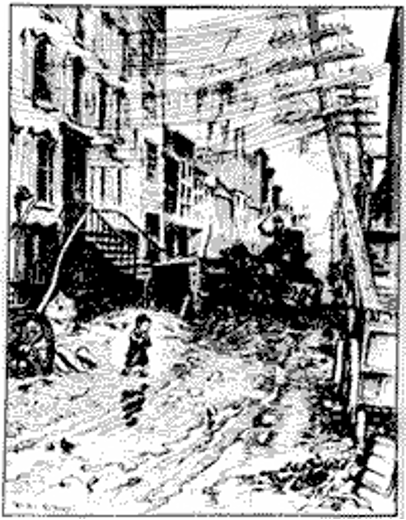
The most major contributor to disease was unsanitary conditions, particularly in overcrowded areas like cities where it ran rife. The medical establishment paid very little attention to this. Even as they developed a better understanding of the nature of disease and infection over the years gone by. They didn’t want people to find out about the sanitation solution: If the people at large had found out, then there wouldn’t have been big profits made on vaccinations; no bonuses for administering them…Get the picture?
In the modern western industrialized world, we take so many things for granted. For example, good practical public health measures in dealing effectively with overcrowded cites is no exception. But in the history of mankind, the idea of sanitation, cleanliness and good clean drinking water has only been implemented in relatively recent times.
Take, for instance, London in the 19th century. The population had risen from 1.1 million in 1800 to 2.2 million in 1850. By all accounts, the city had turned into a putrefied dung heap. The notoriously unclean Jacob’s Island, located at the south bank of the Thames was immortalized by famous writer of the time Charles Dickens, who gave a vivid account:
“… crazy wooden galleries common to the backs of half a dozen houses, with holes from which to look upon the slime beneath; windows, broken and patched, with poles thrust out, on which to dry the linen that is never there; rooms so small, so filthy, so confined, that the air would seem to be too tainted even for the dirt and squalor which they shelter; wooden chambers thrusting themselves out above the mud and threatening to fall into it – as some have done; dirt-besmeared walls and decaying foundations, every repulsive lineament of poverty, every loathsome indication of filth, rot, and garbage: all these ornament the banks of Jacob’s Island.” –Taken from ‘Oliver Twist’
Amongst the squalor and over crowdedness in London, some thirty or so families would share a toilet, where a cesspool would spill out its filthy content into the streets. Hogarth, a famous painter of the era, made a picture showing someone unconcernedly tipping out a po of human faeces from their house and on to the street! Other instances of foul and putrid urban matter included: rubbish heaps, decaying animal detritus from slaughterhouses, overflowing graveyards, horses dung… To make matters worse, water was drunk from wells, pipes, cisterns or tubs…all from the sewage-polluted Thames. Writing to a fried, Sydney smith, a canon of St. Paul’s cathedral made this comment when corresponding to a friend in 1834:
“He who drinks a tumbler of London water has literally in his stomach more animated beings than there are men, women and children on the face of the globe.”
In those days, many were ignorant of the connection between grime and disease. The authorities did not make any real effort to do anything about it until around the 1830’s when an outbreak of cholera occurred, taking the lives of about 31,000 people in the UK, 5,000 in London. From here on things slowly got better, even if it did take a panic to get the authorities to finally get something underway. From here on, through trial and error, control of sanitation got better and its effectiveness was reflected in the decline in the mortality rates over the years.
The same in principle occurred for other westernised industrialized cities such as New York and Chicago.
As we have seen in the graph earlier, the evidence indicates that smallpox mortality had dropped steadily over the years due an improvement in sanitation, cleanliness and good clean water.
The next thing to ask is what about the so-called efficacy of other vaccines? For this, go to Part-2