
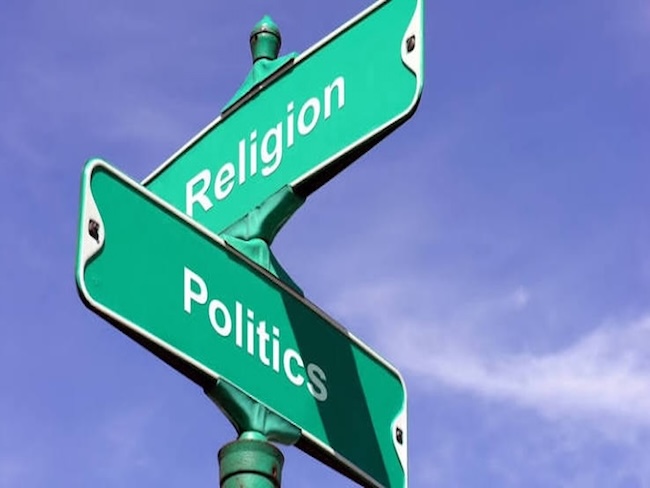
This article is not an attempt to knock anyone’s religion. However, it’s about exploring the eerie similarities between politics and religion. Many people don’t see the related manipulative deception that perpetuates.
-In respect of this, let’s explore the eerie similarities between politics and religion:
* Both politics and religion are subjects you should not argue
It’s always amusing to hear people say you should never argue politics and religion. Sure, many people stay away from political or religious debates avoiding the related “taboo subjects” to avoid social friction.
Does it really have to be this way? The tribal “us versus them” confrontations can be duly avoided through maintaining harmony: We can respectfully agree to disagree. Simply try understanding the political and religious views of others. You don’t have to see it from the perspective of winning versus losing the debate or right from wrong…
-You can simply, just observe.
Consider the quote:
“Skip the religion and politics, head straight to the compassion. Everything else is distraction.”
-Talib Kweli Greene.
* Fake authority claiming to have dominium
Both politics and religion claim to have an authoritative rule over their respective followers. This authoritative rule is fake. The rule only exists because its compliant followers have given their participatory agreement to it.
In other words, it’s reality by group agreement: Just like a bunch of kids who made Father Christmas real purely by their group agreement.
In the case of politics, the granted authoritative rule is represented by one designated government ruler; who has risen to prominence: A president, prime minister or dictator wielding absolute authority. In religion, the church, or sect, the authoritative one-ruler is deemed a “god,” having dominion.
-It’s based on an idea instilled into the minds of many that authority exists in the form of masterful superiority, worship and domination… This article exposes the idiocy and ludicrous ideas behind this narrow viewpoint.
* Political or religious supremacy
Political or religious supremacy is accepted. For example, in religion, the church teaches its followers that the Pope is infallible. A political leader may be haloed as a complete hero, considered by followers to have supremacy over other politicians.
Alternative views are rejected sometimes with disdain regardless of contradiction or challenges to the contrary. Those within the group may even be ostracized for their indifference.
* Followers, with their dogmatic beliefs shut down independent critical thinking
Be it with politics or religion, this happens to the point of cognitive dissonance. Belief cripples enquiry. Followers no longer act as curious, inquiring individuals. They have lost their individuality. They have lost their true identity. They have become easier to control by their ruling authorities.
-Such is the disempowering effect of compliance.
-With so many different political and religious viewpoints, so many different beliefs, how can anyone be sure that any of them are true?
What about the errors, inconsistencies and contradictions that run rife throughout the political/religious spectrum…?
* Followers of their respective politics and religion may isolate themselves
As groups, they may be peer-pressured to disconnect from those outside of the group having alternative views. Sometimes followers disconnect from close members of their family, causing much grief and upset through the painful, emotional disconnection.
-One of the negative, often unforeseen, aspects of collectivism.
Without naming names, for example, certain religious cults have been referred to through their history of family disconnection. Some of these disconnected people never return to see their family again…
* Fundamentalism
Followers may be so heavily programmed or brainwashed that they have become fundamentalists. A number of fundamentalists are willing to kill or die for their politics or religion.
Fundamentalists hold a certain amount of contempt for those outside of their political or religious group. Outsiders are regarded by fundamentalists as those who must be controlled. They have to be indoctrinated into the group’s ideology.
Fundamentalists may even see outsiders as those who need to be enslaved. They may go to extremes to make the enslavement happen, using the fear rhetoric, or whatever it takes…
One of the major tenets of fundamentalism in politics and religion is intolerance. They may act in insidious ways, while preaching or teaching aspects of freedom and love. Acting like they care for you, they will not tolerate any dogmas or actions different from their own ways.
It’s a form of conditional love. -In other words, nothing to do with love. Real love is unconditional.
Opposers showing much opposition to fundamentalists could come to a sticky end.
It has been said that there have been a number of evil senior politicians who have had serious opposers to their political establishment quietly bumped off…
Finally
“Those who believe that politics and religion do not mix, understand neither.”
-Albert Einstein
Not an exhaustive account, I realize, but that concludes the eerie similarities between politics and religion. In a number of ways, we have seen how these similarities give both politics and religion the illusion of freedom through authoritative control, when, in actuality, it’s enslavement.
The sleeping masses just keep on sleeping; many have no idea that this ploy is happening.
-No wonder the rulers of the world see politics and religion as useful tools for manipulative control.